Transfer of Residence (ToR1): Moving Your Belongings Without Paying Duty and VAT
Bringing Your Home Home
Since Brexit, every household move between the UK and Spain is a full international shipment, and that means customs. It sounds far more alarming than it is. There is a long standing relief that exists precisely for people in your position, and once you know how it works, and once someone has walked you through it, it stops being the thing that keeps you awake at night.
That relief is called Transfer of Residence, and the application for it is known as the ToR1. In plain terms, it allows you to bring your own used household belongings into the UK without paying customs duty or the 20 per cent import VAT that would otherwise fall due. On a container of furniture, or on a car, that is not a small saving. It is very often the single biggest number in the whole move.
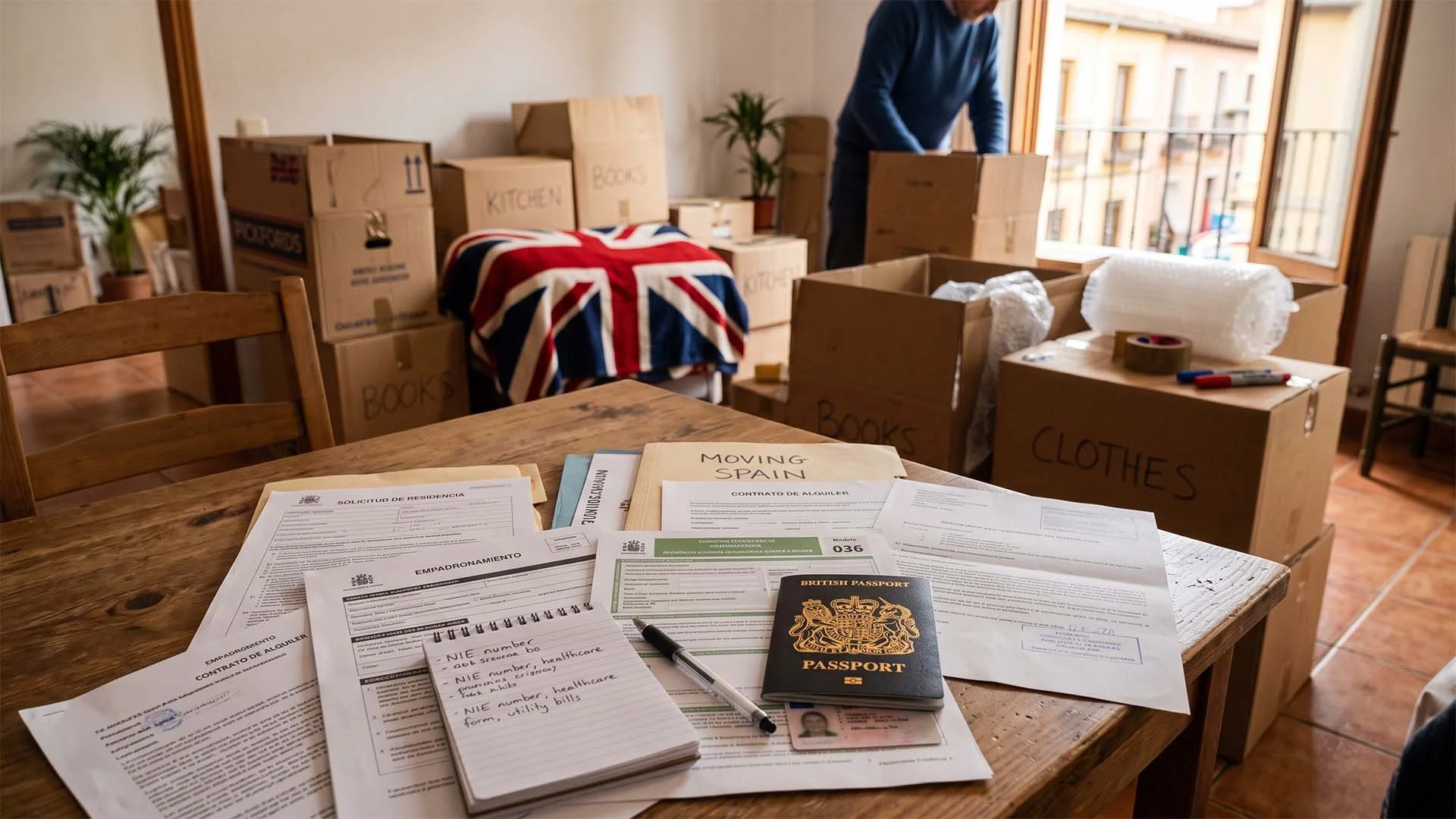
At Home to Home we have been handling customs paperwork for household moves since the current rules came into effect, and we prepare ToR1 applications for our customers as a matter of routine. Here is what the scheme is, who qualifies, and where we fit in.
Which Direction Are You Moving?
This is the point that causes the most confusion, so it is worth being clear about it from the start.
The ToR1 is a UK application, made to HM Revenue and Customs, and it applies when you are bringing your belongings into the UK. So if you have been living in Spain and you are now returning home, whether that is to Rochdale, Ringwood or anywhere else in Great Britain, the ToR1 is your route to duty and VAT free import.
If you are moving in the other direction, from the UK out to Spain, there is an equivalent relief on the Spanish side. It is not called ToR1 and there is no online form to fill in beforehand. Spain applies the European change of residence franchise, and the relief is claimed directly on the import declaration at the point your shipment arrives, supported by your residency and inventory documents. We cover that further down the page, and we handle it for our Spain bound customers through our agents in Alicante.
Both schemes rest on very similar principles, so if you understand one you broadly understand the other.
The Four Conditions for ToR Relief
HMRC applies four main tests. You need to satisfy all of them.
First, you must have been living outside the UK for at least twelve consecutive months before your move.
Second, you must have owned and used the goods for at least six months before they are imported.
Third, the goods must arrive within twelve months of you coming to live in the UK, although they can arrive in more than one consignment within that window.
Fourth, once the goods are here you must not sell, lend, hire out or otherwise dispose of them for twelve months, or the duty and VAT you were relieved of becomes payable after all.
A few things follow from those conditions. The relief is for people genuinely transferring their main home, so it cannot be used to furnish a holiday property or a second home. It applies to living individuals and their own possessions rather than to companies or trusts. And HMRC will consider relaxing the residence, ownership and timing conditions where something outside your control got in the way, though it says plainly that a shortage of funds or a shortage of space will not do.
There are also separate routes for students coming to study in the UK, and for people importing belongings in connection with a marriage or civil partnership, or with an inheritance. If one of those describes your situation, tell us and we will point you to the right one.
What You Can and Cannot Bring
The relief covers the ordinary contents of a home: furniture, linen, furnishings, kitchen equipment, clothing, books, tools and personal effects. It also covers bicycles, motorcycles, private cars and their trailers, touring caravans and pleasure craft, along with household pets and the portable instruments of a trade or profession.
What it does not cover is alcohol and tobacco, commercial vehicles, equipment for a business, anything you intend to sell, and larger non portable trade equipment. It is also worth saying that the relief only removes the tax. It does not remove the need for a licence where one is required, so firearms and anything covered by endangered species rules still need their own paperwork.
Applying: What HMRC Asks For
The application is made online through the GOV.UK service. You will need to sign in with a Government Gateway account, which you can create as part of the process. The official page is here: Application for transfer of residence relief (ToR1).
The inventory usually surprises people, in a good way. HMRC does not want a line by line list of every possession with a value against it. It wants sensible groupings, along the lines of "books, approximately 110" or "cutlery, 40 pieces". Alongside that you will need the photograph page of your passport, proof of your UK address dated within the last three months, proof of your Spanish or other overseas address dated within the last six months, health certificates or pet passports for any animals travelling with you, and full details of any vehicle including the make, model, registration and chassis or VIN number.
When you submit, HMRC issues a submission reference number. When the application is approved, it issues a Unique Reference Number, or URN. That URN is the thing that matters. It goes on the customs declaration when your shipment enters the country, and without it your goods do not get the relief.
One practical warning. You cannot amend an application once it has been submitted, although you can add to it. Getting it right first time is worth the extra half hour.
How Long It Takes, and Why You Should Start Early
HMRC does not publish a target processing time for ToR1 applications. In practice, removal firms report anything from a few days in the quiet months to around six weeks at the height of the summer, when everyone is moving at once. A fortnight is a fair working expectation outside the peak, but it is an expectation rather than a promise.
The lesson from that is simple. Start the application four to six weeks before your intended collection date, and do not let your belongings sail without the URN in hand. If a shipment reaches a UK port without one, it sits there. Storage and demurrage charges begin to build, and you may have to pay the duty and VAT up front to release your own furniture and then reclaim it afterwards. That is a slow, expensive and thoroughly avoidable way to start life back in Britain.
If your dates slip and the paperwork is not ready, we can hold your belongings in our storage in the UK or in Spain until it is. Between the two we can almost always keep a move on track rather than watching it stall at the border.
Applications Are Rarely Refused, They Are Usually Just Inconsistent
Most delays come down to the same handful of things. The name on the passport does not match the name on the utility bill. The proof of address leaves a gap in the twelve month qualifying period. The vehicle VIN is missing. The inventory is too vague to tell HMRC anything useful.
There is no formal appeal against a rejected application, but there does not need to be. You simply correct the problem and reapply, which is usually quicker than an appeal would have been. Better still is to have someone check it before it goes in, which is part of what we do.
Vehicles Need Their Own Timetable
If you are bringing a car, motorcycle or motorhome back to the UK, the ToR1 covers the duty and VAT, but there are two further steps.
You must tell HMRC about the vehicle within fourteen days of it arriving permanently, through the Notification of Vehicle Arrivals system. The DVLA will not register the vehicle until that notification has been processed, and late notification can attract a penalty. After that comes registration itself, which may require an Individual Vehicle Approval certificate for a vehicle that was never type approved for the UK or EU market. The V5C log book can take up to six weeks to arrive.
Going the other way, into Spain, a vehicle needs its customs declaration, adaptation and homologation to Spanish requirements, an ITV inspection and then registration with the DGT. The exemption from the Spanish registration tax on change of residence has to be claimed within sixty days of you establishing residence, and missing that window is costly. Vehicles that were only ever built for the UK market frequently need individual homologation, which takes longer and costs more than a straightforward transfer, so it pays to ask before you assume.
We have moved cars between the UK, Spain and Portugal for more than thirty years, in open and enclosed transport, and we will tell you honestly at the quotation stage what your particular vehicle is likely to involve.
Moving Out to Spain: The Equivalent Relief
For customers heading to Spain, the same broad framework applies. You need to have lived outside the EU for at least twelve months, to have owned and used your belongings for at least six months, to import them within twelve months of establishing residence in Spain, and to keep them for twelve months afterwards.
What differs is the mechanism. There is no advance approval to obtain. Instead the relief is claimed on the Spanish import declaration, the DUA, and it stands or falls on your documents. You will typically need evidence of your previous UK residence, your NIE or TIE, your certificate of empadronamiento from your new Spanish town hall, and a detailed inventory in Spanish with estimated values.
One point that catches British movers out: British consulates in Spain stopped issuing the old "baja consular" letters for customs purposes some years ago, so British nationals prove their prior residence with ordinary UK documents such as council tax bills, utility bills, bank statements and employment records instead. Where residency paperwork is not yet complete, Spanish customs will sometimes clear a shipment against a deposit or guarantee that is refunded once the documents catch up.
Requirements can be interpreted slightly differently from port to port, which is exactly why we work with established customs agents on the Spanish side rather than leaving customers to find one themselves.
Where Home to Home Comes In
Our job does not stop at loading your belongings safely onto the lorry. We are EORI registered, we work with trusted customs agents on both sides of the water, and we prepare and submit the declarations that get your shipment across the border cleanly.
On the ToR1 specifically, we will tell you early in the process whether you are likely to qualify and what evidence you should start gathering. We will guide you through the GOV.UK application and help you complete it correctly, including putting the inventory into the grouped format HMRC actually wants. We will tell you which supporting documents to dig out and check them for the mismatches that cause delays. Once your URN comes through, we quote it on the customs entry ourselves. And if your paperwork and your dates fall out of step, we have secure, clean and dry storage in both the UK and Spain to bridge the gap.
Thirty years of doing this has taught us that the paperwork is not really the difficult part of moving abroad. Leaving is the difficult part. The paperwork is just a sequence of steps, and we know the sequence.
Talk to Us Before You Book Anything
If you are planning a move in either direction and you are not sure where you stand on customs, get in touch before you commit to dates. A ten minute conversation now is worth a great deal more than a rescue operation at the port later.
Call us on +34 711 02 28 16, email info@hthremovals.com, or request a removals quote. If you are moving a vehicle, you can request a vehicle transport quote instead.
This article is a general guide and not formal customs or tax advice. Rules and processing times change, and every move is a little different. The official HMRC guidance can be found at gov.uk/guidance/application-for-transfer-of-residence-relief-tor1 and gov.uk/guidance/transfer-of-residence-to-great-britain. Correct at the time of writing, August 2026.